Passenger Briefing
Passenger Briefing – Why?
As pilots, when we take passengers flying, it is very easy to assume that they have a level of knowledge that they do not actually have. Many of your passengers will never have been in a helicopter before and it is our job to explain to them what they will experience during the flight, safety issues and emergency procedures.
It is important that you have some consideration on how you will deliver this brief as you must get your points across without scaring the living daylights out of them.
The Brief
So here is my idea of a passenger brief. There is no, one, correct way of giving the brief but if this gives you some ideas for your own brief then that is all I am trying to achieve. I tailor this brief depending on my passenger’s personality. Some people want lots of information and some want none (but you have to give them the minimum safety info).
- Location of flight departure point
- Time to arrive at departure point (leave time for briefing etc.)
- Helicopter description
- Location of door handles, door locks, emergency door release handles etc.
- Location and use of fire extinguishers and first aid kits
- What not to touch
- Why it is important for you to be able to talk to ATC. Explain how the intercom isolate switch works (if equipped)
- Approaching and departing the helicopter
- Safety harness operation – not to be removed until rotors stop turning
- Emergency procedures
- The helicopter takeoff profile
Safety Harness
To me, this is one of the most important elements that should be discussed with your passengers. Not only do I verbally explain how the seat-belt or safety harness works but I also demonstrate the release mechanism at the aircraft. Stress the importance of having the seat-belt fastened at all times and that it must not be removed until the blades have stopped turning. If seats are adjustable, now is a good time to explain how to adjust the seats and ensure that they are locked into position.
Climate Control
If your helicopter is equipped with rear passenger or forward passenger climate control or ventilation, explain how this works and show them the control locations. You may want to prohibit your front passenger from operating any controls near the instrument panel. If this is the case, explain to them that you will operate the controls. Stress to the passengers to let you know if they are too hot or too cold.
Airsickness
Personally, I do not brief on the subject of airsickness as I believe that the suggestion can increase the risk of it happening. But if it does occur, you should have a plan. Know where the sick bags are located. Assess the severity of the sickness and decide if it is an inflight emergency. This could also lead to other problems such as hyperventilation etc.
It is up to you on how much to brief on this subject.
Fire Extinguishers
Your passengers should know the location of any fire extinguishers. They should also know how to remove the extinguishers from their attachment points and how to use them by removing any protective pins etc.
Door Operation
The location of the doors will be obvious but some helicopters have tricky door operation that can involve pushing and pulling and sliding. In an emergency, your passengers must be capable of operating the doors. If necessary, get your passengers to open and close the doors from inside the helicopter.
NOTE
In the Robinson R44, it is very easy for the rear passengers to unwittingly hit the locking mechanism with their hand. If this occurs, they will be unable to unlock the door until the locking mechanism is released. Brief these passengers accordingly.
Make sure that the passengers know where to go after exiting the aircraft as it would be unfortunate if the were to run to the rear of the aircraft and suffer injury from the tail rotor.
Communication
Brief your passengers on how you must listen to ATC and sometimes talk to them. Tell them that they are not to talk to you during the take-off and landing phases of flight. If you have a pilot isolate switch for the intercom, explain that when you use this, the passengers will not be able to talk to you and should not expect to do so.
Takeoff Profile
Anyone who has not flown in a helicopter before will almost certainly expect you to take off vertically. Explain that even though we can take off vertically, we prefer to transition into forward flight if we have the space available to us.
Explain how the nose of the aircraft will tilt down but that it is not going to fly into the ground. Explain that the helicopter will remain close to the ground until we reach a certain speed before climbing away.
Questions
Finally, ask your passengers if they have any questions. This is important as some people will have fears and just plain inquisitiveness that you will be in a position to answer.
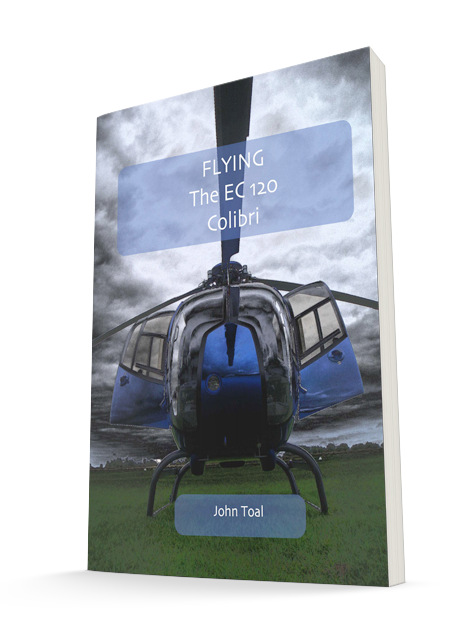
EC 120 Colibri Book
I have just completed a new book for anyone training on the Eurocopter EC120 Colibri Helicopter. This is a training manual that describes all of the systems in detail. There are numerous diagrams and it is all colour.
Details can be found on the Amazon website or on the link below.
As we are not normally allowed to take the Pilot’s Operating Handbook home with us, this book is invaluable for all trainees and pilots.
The Finer Points Of Autorotations
Introduction
Qualified pilots can all do autorotations. Low time pilots can do them but are a little nervous and tentative. Students enjoy doing the autorotations but wonder what it would really be like if they had to do one for real.
The only people I know who are really good at autorotations are flight instructors. They do them every day so they get lots of practice.
My question is – how can we make the autorotation process easier for students?
Assumptions
You should be comfortable with smoothly entering an autorotation by lowering the collective and using aft cyclic while looking ahead.
Bringing the airspeed back to the autorotation speed for your helicopter type.
Controlling the rotor RPM (especially during turns).
Sequence of Events
When you do an autorotation there is a sequence of events that should happen in order for the autorotation to be successful.
- Enter the autorotation
- Establish steady glide at autorotation speed and steady RRPM
- Determine wind direction
- Select a suitable landing area
- Determine which technique you are going to use to reach the landing area
- Mayday call
- Flare
- Land
As we have already assumed that you can enter an autorotation and control your speed and RRPM, we will concentrate on the remaining items.
Determine Wind Direction
We should always be aware of what direction the wind is blowing from – just in case we have to do an emergency landing. This is covered in detail in an earlier post so I will not elaborate further on this subject.
Select a suitable landing area
The best way to select a landing area is to look all around you. Look for the biggest field or landing area close to the helicopter. Do not try to go for distance on this one as it is much, much easier to lose height than it is to gain distance.
Don’t worry if there are cables in the landing area – you can avoid these if you can see them so do not let cables prevent you from using a particular area.
It does not matter if the landing area is on the left or right.
Determine which technique you are going to use to reach the landing area
Now that you have selected a landing area, you can work out what technique you are going to use to reach the area.
- Normal autorotation
- Range autorotation
- Extended range autorotation
- Zero speed autorotation
- “S” turns
- 360 degree turns
Whatever technique you use, try to stay relaxed. You will be descending but you are still flying.
- Wind From Ahead
If the wind is on your nose then all you need to do is determine if you are going to overshoot. If the landing area appears to be moving down the windscreen then you are going to overshoot. Use “S” turns or reduce speed to lose height.
If it remains in the same position on the windscreen then you are going directly to the landing area.
If the landing area appears to be moving up the windscreen during the descent then you will land short. Increase speed to gain distance. - Wind From 3 o’Clock or 9 o’Clock
When the wind is from the side, then you need to decide when to turn into the landing area.
Treat this as part of a circuit. You need to decide when to turn on final – do not leave it too late otherwise you will not reach the landing area.
The rest of the procedure is as described in 1 above. - Wind From Behind
Treat this as the downwind leg of a circuit. Do not wait too long before turning. You need to decide when to turn on base – do not leave it too late otherwise you will not reach the landing area. Turn on base and then decide when to turn on final.
The rest of the procedure is as described in 1 above.
Mayday call
Do not stress over the mayday call. You will not be remembered for getting a great mayday call out if you subsequently crash – Fly the aircraft. Only if you have time and the conditions are right should you do a mayday call. Mayday calls get easier with practice so make sure you practice them and then you can do them quickly.
E.g. “Mayday Mayday Mayday.
ABC Approach. EI-DEF
Engine failure 4 miles northwest of Athlone
Forced Landing”
If you can get the above information out before you lose too much altitude then you are doing well. You can give extra information if you like but it is important to not get sidetracked or distracted. Practice this while driving to improve multitasking.
Flare
The flare is described in detail in a previous post on autorotations.
Land
The autorotative landing is described in detail in a previous post on autorotations.
Summary
It really is a case of practice makes perfect. Treat the approach like you would a circuit. Do your turns early rather than late. If you turn late then you increase your chances of landing short. If you turn early you have the option of doing further “S” turns to lose height.
Note the position of the landing area on your windscreen when you practice autorotation so that you have a good idea what your glide angle is for your helicopter type.
Dangerous Goods
Introduction
As pilots we take passengers with us on flights whether for business or for pleasure. But when is the last time you asked them what was in their bags? Do you know what amount of alcohol is permitted on board. Does it have to be kept in the luggage compartment or can it be carried in the cabin? How many hair straighteners can be taken on board? Etc.
These are questions we should be looking at as ultimately, we are the ones responsible for the safety of the flight.
I have compiled a table using information from IATA which may be useful to you as a reference.
Dangerous Goods Definition
According to the International Air Transport Association (IATA), dangerous goods are articles or substances which are capable of posing a risk to health, safety, property or the environment and which are shown in the list of dangerous foods in the regulation or which are classified according to the regulations.
Dangerous Goods General
Some dangerous goods are too dangerous to be carried by aircraft, others may be carried on cargo aircraft only and some are acceptable on both cargo and passenger aircraft. A number of limitations are placed on dangerous foods which are permitted to be transported by air. These limitations are established by the regulations but your country may impose extra regulations.
Dangerous Goods Forbidden In Aircraft Under Any Circumstances
Any article or substance which is liable to explode, dangerously react, produce a flame or dangerous evolution of heat or dangerous emission of toxic, corrosive or flammable gases or vapours under conditions normally encountered in transport must not be carried in aircraft under any circumstances.
Dangerous Goods Forbidden Unless Exempted
The dangerous goods described in paragraphs (1) to (5) must not be carried in aircraft unless exempted by the particular country you are flying in.
- Radioactive material which is:
- In vented type packages
- In packages which require external cooling
- In packages subject to operational controls during transport
- Explosive
- A pyrophoric liquid
- Unless otherwise provided, articles and substances with a UN number which are identified in the “List of Dangerous Goods” as being forbidden
- Infected live animals
- Liquids having a vapour inhalation toxicity which requires special packaging
- Substances that are offered for transport in a liquid state at temperatures equal to or exceeding 100 degrees Celsius or in a solid state in temperatures equal to or exceeding 240 degrees Celsius
- Any other articles or substances as specified by the country you are flying in
|
Type of dangerous good |
|||||
|
The pilot-in-command must be informed of the location… |
|||||
|
The approval of the operator is required… |
|||||
|
Permitted on ones person… |
|||||
|
Permitted as checked in baggage… |
|||||
|
Permitted as carry on baggage… |
|||||
| Disabling devices such as mace, pepper spray, etc. containing an irritant or incapacitating substance are prohibited on the person, in checked and carry-on baggage. | X | X | X | - | - |
| Electro shock weapons (e.g. Tasers) containing dangerous goods such as explosives, compressed gases, lithium batteries, etc. are forbidden in carry-on baggage or checked baggage or on the person. | X | X | X | - | - |
| Security-type attaché cases, cash boxes, cash bags , etc. incorporating dangerous goods, such as lithium batteries and/or pyrotechnic material, are totally forbidden. | X | X | X | - | - |
| Ammunition (cartridges for weapons), securely packaged (in Div. 1.4S, UN 0012 or UN 0014 only), in quantities not exceeding 5 kg (11 lb) gross weight per person for that person’s own use, excluding ammunition with explosive or incendiary projectiles. Allowances for more than one passenger must not be combined into one or more packages. | X | √ | X | √ | X |
| Camping stoves and fuel containers that have contained a flammable liquid fuel, with empty fuel tank and/or fuel container. | X | √ | X | √ | X |
| Battery-powered wheelchairs or other similar mobility devices with non-spillable batteries which comply with Packing Instruction 872 or Special Provision A67, provided the battery terminals are protected from short circuits, e.g. by being enclosed in a battery container, and the battery is securely attached to the wheelchair or mobility aid. | X | √ | X | √ | X |
| Battery-powered wheelchairs or other mobility devices with spillable batteries or with lithium batteries. | X | √ | X | √ | √ |
| Mercury barometer or thermometer carried by a representative of a government weather bureau or similar official agency. | √ | X | X | √ | √ |
| Lithium ion batteries with a Watt-hour rating exceeding 100 Wh but not exceeding 160 Wh for portable electronic devices. No more than two spare batteries may be carried in carry-on baggage only. These batteries must be individually protected to prevent short circuits. Equipment containing such batteries may be in checked or carry-on baggage. | √ | X | √ | √ | X |
| Avalanche rescue backpack, one (1) per passenger, equipped with a pyrotechnic trigger mechanism containing less than 200mg net of Division 1.4S and less than 250 mg of compressed gas in Division 2.2. The backpack must be packed in such a manner that it cannot be accidentally activated. The airbags within the backpacks must be fitted with pressure relief valves. | √ | √ | X | √ | X |
| Chemical Agent Monitoring Equipment when carried by staff members of the Organization for the Prohibition of Chemical Weapons on official travel. | √ | √ | X | √ | X |
| Heat producing articles such as underwater torches (diving lamps) and soldering irons. | √ | √ | X | √ | X |
| Carbon dioxide, solid (dry ice), in quantities not exceeding 2.5 kg (5lb) per passenger when used to pack perishables not subject to these Regulations in checked or carry-on baggage, provided the baggage (package) permits the release of carbon dioxide gas. Each item of checked baggage must be marked “dry ice” or “carbon dioxide, solid” and with the net weight of dry ice or an indication that there is 2.5kg or less dry ice. | √ | √ | X | √ | X |
| Insulated packagings containing refrigerated liquid nitrogen (dry shipper), fully absorbed in a porous material and intended for transport, at low temperature, of non-dangerous products are not subject to these Regulations provided the design of the insulated packaging would not allow the build-up of pressure within the container and would not permit the release of any refrigerated liquid nitrogen irrespective of the orientation of the insulated packaging. | √ | √ | X | √ | X |
| Non-flammable gas cylinder fitted into a life jacket containing carbon dioxide or other suitable gas in Division 2.2, up to two (2) small cylinders per passenger, and up to two (2) spare cartridges. | √ | √ | √ | √ | X |
| Oxygen or air gaseous cylinders required for medical use. The cylinder must not exceed 5 kg gross weight. Note: Liquid oxygen systems are forbidden for transport. |
√ | √ | X | √ | √ |
| Portable medical electronic devices (Automated External Defibrillators (AED), Nebulizer, Continuous Positive Airway Pressure (CPAP), etc.) containing lithium metal or lithium ion cells or batteries may be carried. | √ | √ | √ | √ | X |
| Aerosols in Division, with no subsidiary risk, for sporting or home use. | X | √ | X | X | X |
| Non-radioactive medicinal or toilet articles (including aerosols) such as hair sprays, perfumes, colognes and medicines containing alcohol. The total net quantity of all above mentioned articles must not exceed 2 kg (4.4 lb) or 2 L (2 qt), and the net quantity of each single article must not exceed 0.5 kg (1 lb) or 0.5 L (1 pt). Release valves on aerosols must be protected by a cap or other suitable means to prevent inadvertent release of the contents. |
√ | √ | √ | X | X |
| Alcoholic beverages, when in retail packagings, containing more than 24% but not more than 70% alcohol by volume, in receptacles not exceeding 5L, with a total net quantity per person of 5L. | √ | √ | √ | X | X |
| Energy efficient light bulbs when in retail packaging intended for personal or home use. | √ | √ | √ | X | X |
| Non-flammable, non-toxic gas cylinders worn for the operation of mechanical limbs. Also, spare cylinders of a similar size if required to ensure an adequate supply for the duration of the journey. | √ | √ | √ | X | X |
| Portable electronic devices containing lithium metal or lithium ion cells or batteries, such as watches, calculating machines, cameras, cellular phones, lap-top computers, camcorders, etc., when carried by passengers or crew for personal use. | √ | √ | √ | X | X |
| Spare lithium or lithium ion cells or batteries, for such consumer electronic devices may be carried in carry-on baggage only. These batteries must be individually protected to prevent short circuits. | √ | X | √ | X | X |
| Hair curlers containing hydrocarbon gas, up to one (1) per passenger or crew-member, provided that the safety cover is securely fitted over the heating element. These hair curlers must not be used on board the aircraft at any time. Gas refills for such curlers are not permitted in checked or carry-on baggage. | √ | √ | X | X | X |
| Medical or clinical thermometer, which contains mercury, one (1) per passenger for personal use, when in its protective case. | √ | √ | √ | X | X |
| Fuel cell systems, and spare fuel cartridges powering portable electronic devices (for example cameras, cellular phones, laptop computers, and camcorders). | √ | X | √ | X | X |
| Radioisotopic cardiac pacemakers or other devices, including those powered by lithium batteries, implanted into a person, or radiopharmaceuticals contained within the body of a person as the result of medical treatment. | X | X | √ | X | X |
| Safety matches (one small packet) or a cigarette lighter that does not contain unabsorbed liquid fuel, other than liquefied gas, intended for use by an individual when carried on the person. Lighter fuel and lighter refills are not permitted on one’s person nor in checked or carry-on baggage. Note: “Strike anywhere” matches, “Blue flame” or “Cigar” lighters are forbidden. |
X | X | √ | X | X |
Helicopter Preflight
Preparing For Flight
We all go out to our helicopter and complete our daily preflight inspection before flying. But what exactly does the preflight consist of? Is it just a matter of checking the mechanics of the helicopter? Of course this is a very important check but there are many more things to check and consider.
- Licence expiry date
- Medical expiry date
- LPC renewal date
- Aircraft documentation
- Location of helicopter
- Fuel
- Mass and balance
- Meteorological reports
- Fitness for flight
- Passenger brief
- Dangerous goods
- Airport layout and procedures
- Planning, ATC and route
- Performance
- Equipment
- Prior permission to land at destination
Some of the above items may seem obvious to you but I bet that you do not check all of them. I may even have missed a few. But let’s look at these in a little more detail.
Licence expiry date
Were you aware that your JAR licence has an expiry date? Take it out and have a look at it. It is not obvious but normally, on the second or third page, there will be an expiry date. Put this date in your calendar and set an alarm to remind you to renew it – no one else is going to do this for you. There will be no letters to remind you.
Your licence is only valid for five years. This is separate from your type rating.
Obviously you must not fly if it has expired.
Medical expiry date
Check the expiry date of your medical certificate. Do you have to wear corrective lenses? Do you have a second pair as stated on your medical certificate?
Again, program the expiry date into your calender with an alarm to remind you to renew it before it expires.
LPC renewal date
Check the date when your LPC is due for renewal for the type of aircraft you are flying. Use the calender again.
Aircraft documentation
Make sure the aircraft is airworthy. Check the following documents:
- Certificate of Registration (CoR) (no expiry date).
- Certificate of Airworthiness (CoA). This is being replaced by an Airworthiness Review Certificate
- Certificate of Release to Service (CRS). Check that the helicopter has not exceeded the hours and dates for required maintenance.
- Airworthiness Review Certificate (ARC). This is an ongoing, continuous airworthiness program certificate. Check the expiry date.
- Noise Certificate (no expiry date)
- Aircraft Station License (for radio equipment) (no expiry date).
- Third party liability insurance (check the expiry date).
- Mass and balance schedule
- Rules of interception. This is required by law in Ireland or when crossing an international FIR.
- Technical log for the aircraft. Make sure it is up to date and check to see if any defects have been reported.
- Pilot’s Operating Handbook (Flight Manual).
Location of helicopter
The location of the helicopter is relevant before taking off.
- Is it pointed into wind?
- Is there a risk of someone walking into the tail rotor? If so, reposition before starting.
- Check the proximity of buildings. Is there a risk of recirculation? Is anything projecting over the helicopter that may be a hazard after takeoff?
- Check for debris on the ground that may move from the down-wash and possibly circulate into the rotor disc.
- Check the proximity of other aircraft. Is your down wash going to cause damage?
- Are the skids frozen to the ground or stuck in mud?
Fuel
Dip the fuel tanks if possible. Make sure you know exactly how much fuel you have on board. Do not rely on the figure entered into the technical log by the previous pilot.
Do the fuel drains and check for contaminants.
Mass and balance
Perform the mass and balance calculations for your helicopter. Remember – if you are over the AUW or outside the centre of gravity limits, the aircraft is not insured and you may have handling difficulties.
Meteorological reports
It is a legal requirement in Ireland that the pilot checks the weather is suitable for the flight. This means that the weather at the departure, en-route and destination is suitable for the flight. It is much easier to cancel the flight on the ground than it is to cancel it after you have taken off.
Fitness for flight
Are you fit to fly? Consider the following:
- Are you taking medication?
- When is the last time you were drinking alcohol?
- Were you diving in the previous 24 hours?
- Has there been a death in the family?
- Have you recently had a row with a family member or friend?
- Are you suffering from an injury?
- Do you have a head cold?
You get the idea. If any of the above apply to you, consider doing something other than flying.
Passenger brief
Prepare a passenger brief. It is easy to think that safety items are obvious to everyone. Assume that they know nothing. Consider the following briefing points:
- Touching controls
- Seat belt operation
- Door operation
- Sunglasses and baseball cap
- Headphones and microphone. Intercom system. Pilot isolate switch.
- Cameras
- Motion sickness
- Tail rotor
- Egress after emergency landing
- Luggage space available
Dangerous goods
Are you familiar with dangerous goods? No? Then have a think about it. How many bottles of vodka can you carry before it becomes dangerous? Cigarette lighters? Hair straighteners. Batteries etc. All of these can be a hazard in the aircraft. I will write about this in detail in another article. However if you are in doubt, talk to someone and get advice.
Airport layout and procedures
Ensure you are familiar with the airports layout. Have a photocopy of the layout on your knee board for reference. Know the noise abatement procedures and circuit heights. Learn the Visual Reporting Points (VRP’s).
ATC and route
Have a list of the radio frequencies that you are going to need (for the whole route) in your knee board. Ensure that you have the correct frequencies tuned into the radio before you start up. If you are told to change frequency, do not wait 5 minutes to do so. Change to the frequency when told to do so otherwise you will forget and stress levels will increase.
Performance
Check the following:
- Vne for the altitude and weight required – doors off operation.
- Maximum Continuous Power (MCP)
- 5 Minute takeoff rating
- HIGE and HOGE performance for the weight and density altitude (if available)
Equipment
Are you familiar with all of the equipment on the helicopter? Do you know how to use the:
- Intercom system
- Emergency locator transmitter
- GPS
- Floatation equipment
Do you have:
- Charts for the area you are going to be flying in. 1:500,000, 1:250,000, 1:50,000
- Knee board
- Planning log – nav route, frequencies, fuel plan etc.
- Sunglasses
- Aircraft documentation
- Telephone
- Spare engine oil
- Batteries for your GPS or headset
- Emergency numbers – base, ATC etc.
Prior permission to land at destination
Do not land on someones property without permission. Prior permission is required and although verbal permission is sufficient, it is a simple matter to get this in writing. An email will suffice. Written permission is (in my opinion) essential when landing on private property.
Summary
Prior planning will make your flight much more stress free and therefore much more enjoyable. Your helicopter preflight is a vital part of your planning.
Accidents in aviation nearly always happen due to a chain of events. Each event on its own may seem negligible but may lead to more and more severe consequences. Take time to plan properly and you will be able to break the chain or even prevent the chain forming.
Flying is fun and when planned properly – it is also safe. Let’s help keep it that way.
Vortex Ring – Settling With Power
What is Vortex Ring – Settling With Power?
Vortex ring is commonly called settling with power in the USA. Settling with power is a better descriptive name but vortex ring is technically more correct.
When the helicopter is descending into its own induced flow, there is a risk of vortex ring developing. If the rate of descent is high enough, raising the collective to reduce the rate of descent will make matters worse and the rate of descent will actually increase.
Vortices are always present at the tips of all rotor blades. These vortices can be reduced by good design but they can never be completely eliminated.
Vortices decrease the efficiency of the blades. The outer one third of the main rotor blades produce most of the lift. Losing any lift at the tips due to vortices has a large effect on the total lift generated by the blades.
During vertical descents, the opposing airflow from below changes the relative airflow and the angle of attack of the main rotor blades is increased. Due to washout (blade twist) on the main rotor blades and also the low rotational velocity of the blades close to the hub, the angle of attack is increased so much that this part of the blade starts to stall causing a vibration in the helicopter.
Raising the collective to reduce the rate of descent while the helicopter is in vortex ring has two effects:
- The vortices get bigger and move inboard from the tips of the blades thus reducing lift further and causing the helicopter to descend faster.
- The stalled area of the blades close to the hub starts to move outboard and lift is further reduced causing the helicopter to descend even faster.
Conditions For Vortex Ring – Settling With Power
Do you remember what the conditions are for entry to vortex ring? I have come across quite a few qualified pilots who know how to recover from vortex ring and what it is but they do not know all of the conditions that cause vortex ring. Do you?
To get a helicopter into vortex ring, three elements must be occurring at the same time. These are:
- High rate of descent (> 500 ft./min)
- Low indicated airspeed (< 30 kts)
- Power applied (> 20% of power available)
All three of these elements MUST be present.
Symptoms of Vortex Ring
When vortex ring starts to develop you will have a high rate of descent and a low indicated airspeed. As the inboard part of the rotor blades start to stall, a vibration will be felt throughout the airframe. If you have not already noticed the rate of descent and airspeed, this should make you take notice and give you time to recover.
When it develops further, the vortices from the main rotor tips start to interfere with the efficiency of the tail rotor. This can cause random yawing and it must be controlled by the pedals. The pedal movements can be quite large. Start the recovery as soon as possible.
Recovery From Vortex Ring
The recovery is fairly simple. Lower the collective slightly and use forward cyclic to increase airspeed. When the airspeed reaches 30 kts, vortex ring will no longer be present. Entering autorotation (removing “Power” from the equation) will also stop vortex ring as there will be no induced flow but this is not a practical recovery technique. At some stage the rate of descent must be reduced and if the collective is raised, an induced flow is created. This has the effect of re-establishing the helicopter into the vortex ring state again (probably worse than before).
Vortex Ring Scenarios
Scenario 1 Imagine you have just passed your flight test and you now have a brand new PPL(H) licence. Your friends have helped you celebrate and you have promised Alan a free flight. You brief him and take off to go view his house as he wants to take a few photos. As you approach the house, you slow down to 40kts and hold 500’ AGL. Alan asks you to slow down so he can get a photo of his wife in the back garden and then he asks you to hold the helicopter steady in the hover. (Everyone knows that all helicopters hover – right). You come back on the cyclic and lower the collective to stop the helicopter climbing. As the helicopter slows down, it starts to lose translational lift and descend. You have very few visual ques to see this and it goes unnoticed. As the helicopter descends faster you start to feel a vibration and then you notice the high rate of descent. You naturally raise the collective to reduce the rate of descent but this only makes it worse. If you had altitude you could recover easily like you did during training. There is not enough altitude to recover and you hit the ground hard! Scenario 2You are enroute from A to B. The weather forecast at A and B is good but you fly into un-forecast bad weather. As the cloud base gets lower you descend to remain clear of cloud (you know how dangerous it is to fly into cloud). The visibility is deteriorating and you slow down to compensate. You are now following a truck on the motorway below you and you notice that its lights are on. You slow down further as you are aware of hills in the vicinity. You are now flying at 500’ AGL and 40kts with 1000m visibility. There is so much drizzle and moisture in the air that clouds are forming and dissipating around you. Suddenly a cloud forms just in front of you and you start to lose sight of the truck. You come back on the cyclic to slow the aircraft down to avoid entering the cloud. Realising that this is not going to work, you lower the collective to lose altitude. You now have all three conditions for vortex ring and not enough altitude to recover.
Renewing Your JAR Licence
JAR Licences and Type Ratings
Just today I had a pilot ask me about what was involved in renewing a type rating and it gave me the idea to write this post and clarify a few things.
Once you have a PPL(H) licence, it is valid for 5 years. If it expires, you cannot fly. However it is a simple matter to renew the licence. Just phone up the Irish Aviation Authority Licencing Department (or the relevant Authority for your country) and pay them the required fee and they will issue you with a new licence – simple.
The type ratings on your licence are only valid for one year. Type ratings are “revalidated” or “renewed” to keep them current on your licence. It is referred to as revalidated when the type rating has not expired and as renewed when it has expired.
- To revalidate a type rating, you must have flown at least 2 hours in the previous year and pass a Licence Proficiency Check (LPC) up to 90 days before the expiry date of the rating. Should you fail the LPC, you cannot fly as pilot in command until you subsequently pass it. If you pass the LPC, the expiry date is extended one year from the date on which it was due to expire.
An LPC is required for each type on your licence if you wish to continue flying each type. Remember that Ireland implements SFAR 73 safety awareness training if you fly Robinson R22 or R44 helicopters and this must be signed off in your log book before doing the LPC (if applicable). - To renew a type rating means that you have let the type rating lapse. This is not a problem as long as it has not expired more than 5 years.If it has expired less than 5 years, all you need to do is speak to the IAA. The IAA will ultimately decide on how much flying training you have to do. They will request that you be assessed by a training school and the school will then take you for a flight. This flight may be sufficient for your training or you may need further training. When you are at a satisfactory performance level, the school will make an application to the IAA for your flight test to renew the type rating. In my experience, if you are reasonably current on the helicopter type.
If the type rating has expired more than 5 years, you will have to do the type rating course again.
The Licence Proficiency Check (LPC)
The LPC will invlove a flight check with an examiner. The flight will normally be between 45 minutes and 1 hour duration. The following flight exercises are included:
- Climbs and descents
- Straight and level flight
- Steep turns (min 30 degrees angle of bank) left and right
- Vortex ring recovery
- Confined area approach and departure
- Autorotations (combinations of “S” turns, datum and/or 360 degree turns) to 500′ agl with recovery
- Simulated IMC flight (straight and level, turns onto predetermined headings)
- Simulated hydraulics off landing(s) (if applicable)
- Full down autorotation(s)
- Hovering
- Spot turns (left and right)
- Sideways and backwards flight
- Takeoffs and landings (in all wind directions)
- Sloped ground takeoffs and landings
- Limited power takeoffs and landings
- Quickstops
Make sure you know the emergency procedures for the type of aircraft you are flying as you will be quizzed on these. Also ensure that you know how to perform the daily pre-flight check.
To renew a type rating or to revalidate a type rating is a fairly simple process. If you are in any doubt about what is involved, talk to your local school or instructor.
Converting an ICAO PPL(H) to a JAR PPL(H)
Converting From a FAA PPL(H) to a JAR PPL(H)
If you hold an ICAO PPL(H) you may want to convert it to a JAR PPL(H). If you have a FAA PPL(H) you can still fly in Ireland in an Irish registered helicopter.
If you want to hire a helicopter in Ireland and fly using your FAA licence, you will probably have to do some training with the school that you are hiring the helicopter from (it is unlikely that they will just give you a helicopter without seeing how well you fly).
JAR will be changing to EASA in Ireland sometime in 2013. For the most part there will not be a noticeable difference on how things operate in Europe but one of the major concerns for ICAO PPL(H) holders is that they will only have one year to convert their licence to an EASA PPL(H) if they want to continue flying in Europe.
If you intend to get a JAR CPL(H), ATPL(H) or FI(H), you would be advised to build your hours using your ICAO licence and then convert to the relevant JAR licence. This will probably save you a lot of money.
Converting Your Licence
To convert an ICAO PPL(H) or to convert a FAA PPL(H) licence to a JAR (soon to be EASA) PPL(H) licence you will have to have 100 hours of flight time in helicopters. You will also need to get a Class 2 medical. There are two multiple-choice exams that need to be sat:
- Air Law
- Human Performance and Limitations
You will have some flying training to do also. You have to have done a type rating on the type of helicopter you intend to fly. This normally involves 5 hours of flight training but may be reduced to 2 hours depending on your experience.
After you pass your flight test which normally takes less than 1 hour (no navigation) and after you pay the necessary fees, you will be issued with your JAR PPL (H) licence. You have now managed to convert an ICAO PPL(H) to a JAR PPL(H). Of course, if you have a FAA Licence then the same process applies when converting from a FAA PPL(H) to a JAR PPL(H).
Once you have your JAR PPL (H) you can work towards the JAR CPL (H).
JAR CPL(H) Requirements
I have recently had inquiries about training for the Commercial Pilot’s Licence (Helicopters) [CPL(H)].
The JAR CPL(H) is certainly one of the most expensive licences to get in the world today and the written exams are no walkover. It takes dedication and hard work to get this licence.
EASA will be replacing JAR in April 2012. This means that anyone who wants to fly in Europe will require a JAR licence. Foreign licenced pilots will be given one year to convert their licence to the European standard if they wish to continue working in Europe.
The flight skills for the JAR CPL(H) are no different than those required in most other modern countries. In the last few months, there seems to be more interest in obtaining the CPL(H) and there also seems to be more job opportunities – even for low time pilots with no turbine experience.
This post is aimed at providing you with the information you need to see what is required to become a CPL(H) in Europe.
Types of CPL(H) Course
There are two types of CPL(H) course available under JAR.
- The Modular CPL(H) course
- The Integrated CPL(H) course
The modular course requires you to obtain a PPL(H) before passing the CPL written exams and then completing a 30 hour flight course and requires a minimum of 185 hours flight time. This course is by far the most common and allows you to work at your own pace.
The integrated course is a full time course only offered by a few training schools. A PPL(H) is not required. The aim is to concentrate on producing a commercial pilot. Over a period of at least 9 months, you study and pass all of the CPL(H) exams and also fly 135 hours. At the end of the training, you must pass a flight test and you will be issued with a CPL(H). This is by far the cheapest way of getting a JAR CPL(H)
The Modular CPL(H) Course
Before commencing a CPL (H) modular course you should:
- hold a valid Class 1 Medical Certificate,
- be the holder of a PPL(H) issued in accordance with ICAO Annex 1,
- have completed 155 hours flight time as a pilot in helicopters, including 50 hours as PIC of which 10 hours shall be cross-country (105 hours as pilot in helicopters if holder of a CPL(A), 135 hours as pilot in helicopters if holder of a PPL(A),
- If not already holding a night qualification or rating, have completed 5 hours night flight time as set out in JAR-FCL 2.165(b),
- meet the requirements of paragraph 2.3.1 (Theoretical Knowledge) below, be proficient in the use of the English Language and have demonstrated to the HOT/CFI a sufficient knowledge of maths/physics appropriate for the CPL (H) flying training course theory course,
- hold a valid type rating, or, in the case of students who do not hold a type rating before the commencement of the course, carry out a type rating skill test on the applicable helicopter type at the end of the course, which may be completed as part of the CPL (H) LST. The Type Rating training must be in accordance with the requirements of the Sky West ATO Training Manual.
- have completed SFAR 73 safety training – if the applicant is to undertake the course using a Robinson helicopter.
This means that you must have a PPL(H) and completed 155 hours of flight time in helicopters. If you have not done any night flying, you will have to do an extra 5 hours during the commercial flight course.
Depending on where you do your training, you may have to do a correspondence course as part of your studying for the CPL written exams. Theoretical knowledge instruction must be carried out at an Approved Training Organisation (ATO). The modular course involves 30 hours of flying (35 hours if night flying is required). At the end of your training, you should have a minimum of 185 hours flight time.
The 30 hours of flying training will normally be carried out over a 4 week period. General handling is revised. A large part of the flying will be navigation and there will also be some instrument flying.
Having completed the theoretical exams for the CPL(H), you must aim to have completed all your training and passed the CPL skills test within 36 months of achieving a partial pass in the written exams. Otherwise you may have to resit the exams.
Crediting of Flight Time
From the 185 hour flight time:
- 20 hours as pilot in command holding a PPL(A); or
- 50 hours as pilot in command holding a CPL(A) may have been completed in aeroplanes; or
- 10 hours as pilot in command in touring motor gliders or gliders.
The Integrated CPL(H) Course
You must meet the following requirements prior to undergoing a CPL course:
- Minimum age: You must be at least 18 years old before commencing training.
- Educational requirements: You must have sufficient Aeronautical Aptitude and knowledge of Mathematics, Physics and English language to have a reasonable chance of passing all aspects of the course. Level 4 English language proficiency will be the minimum acceptable level for entry to the course.
- Medical requirements: An applicant for the CPL (H) Integrated Course shall hold a valid Class 1 medical certificate. The medical requirements need to be in place prior to commencing the course.
The course will last between 9 and 24 months and is full time.
The course comprises both theoretical knowledge training for the CPL and also visual and instrument flight training.
JAR documentation requires a minimum of 300 hours instruction for the theory but as far as I am aware, no school is doing this course with less than 550 hours theory instruction. The theory subjects are:
- Air Law
- Aircraft General Knowledge
- Flight Performance and Planning
- Human Performance and Limitations
- Meteorology
- Navigation
- Operational Procedures
- Principles of Flight
- Communications
Flying Training
The flying training shall comprise a total of 135 hours, to include all progress tests, of which up to 5 hours of the entire course may be instrument ground time. Within the 135 hours total, you must complete at least:
- 85 hours of dual instruction
- 50 hours as pilot in command; to include at least 14 hours solo day, 1 hour solo night and may include 35 hours as SPIC.
- 10 hours dual cross country flying;
- 10 hours of cross country flight as pilot in command including a VFR cross country flight totalling at least 185km (100nm) in the course of which full stop landings at two different aerodromes from the aerodrome of departure shall be made;
- 5 hours flight time in helicopters shall be completed at night comprising 3 hours of dual instruction including at least 1 hour of cross country navigation and 5 solo circuits. Each circuit shall include a takeoff and a landing.
- 10 hours of instrument dual instruction.
Credits for Previous Experience
An applicant for a CPL(H) may be admitted to training either as an ab-initio student, or as the holder of a PPL(H), issued in accordance with ICAO Annex 1.
In the case of a PPL(H) entrant, 50% of the helicopter hours flown by the entrant prior to the course may be credited towards the required flight instruction up to a maximum of:
- Up to 40 hours, of which up to 20 hours may be dual instruction OR
- If a helicopter night qualification has been obtained, up to 50 hours, of which up to 25 hours may be dual instruction.
This credit for the hours flown shall be at the discretion of the ATO.
Summary
So you have choices to make. Do you go for the modular CPL(H) or the integrated CPL(H)? Of course you may decide to do the ATPL written exams instead of the CPL written exams and I would certainly recommend this. For only a little extra studying, you will have the ATPL exams which are essential if you intend to work with the bigger companies on the oil or gas rigs.
But there is more. After you get your JAR CPL(H) you more than likely have another decision to make. You will probably require either a Flight Instructor rating or an Instrument Rating. But more of that later.
Tail Rotor Failure
Different Types of Tail Rotor Failure
While training for a JAR PPL(H) licence, you will be told about tail rotor failures. There is no flight exercise for tail rotor failures under the JAR system however I like to demonstrate the different types of tail rotor failure that can occur during flight. They are as follows:
- Tail rotor failure in the hover
- Tail rotor failure in forward flight
- Stuck left pedal
- Stuck right pedal
Although tail rotor failures are extremely rare, I have been unfortunate enough to have experienced one. Because of my training, I was able to identify it and land safely. If you have a sufficiently large, flat area, there is no reason why you should not be able to do the same should this ever happen to you.
Some books that cover this topic are:
Tail Rotor Failure in the Hover
When the tail rotor fails while hovering, the nose of the helicopter will yaw rapidly to the right (in helicopters that have a rotor that turns anti-clockwise when viewed from above). You will automatically apply more and more left pedal to try and compensate but this will have no effect and you will eventually reach a point where you have full left pedal applied but the helicopter is still yawing to the right. You should now have realised that the tail rotor is not working.
You must immediately roll off the throttle and perform an engine off landing from the hover. By rolling off the throttle, you will have eliminated the torque and the helicopter will stop yawing immediately. Keep the helicopter level and let it settle. Just before the skids touch the ground, start raising the collective to reduce the rate of descent.
If your helicopter type uses a correlator to adjust the throttle (e.g. R22, R44, H269) make sure that you roll the throttle past the detent to prevent the correlator from opening the throttle up again as you raise the collective.
Tail Rotor Failure in Forward Flight
In forward flight, a tail rotor failure may not be noticed right away if you are traveling at high speed. At lower speeds it is noticeable by a nose right yaw (in helicopters that have a rotor that turns anti-clockwise when viewed from above). If airspeed is reduced, the helicopter will yaw further to the right.
The only option here is to eliminate the torque by lowering the collective and closing the throttle. Obviously you will have to perform an engine off landing but this should not be a problem to you if you have flat ground below.
On touch down, try to run on slightly. The helicopter will try to turn to the left as it slides along the ground. This could cause the helicopter to roll over but there is a way that you can prevent this from happening. If you open the throttle slightly, the increased torque will turn the nose to the right and if you close the throttle, the decrease in torque will turn the nose to the left.
I use a simple trick for this. Stick your left index finger straight out as you grip the collective. When you open the throttle, your index finger points right. This is the direction the nose will yaw and it will yaw by approximately the same number of degrees as the movement your index finger made. (Vice verse for closing throttle). So, by adjusting the throttle, you can prevent the aircraft from rolling over.
Stuck Left Pedal
It is possible that you may find yourself in the position that the left pedal is stuck in position (to the left) during flight. This could occur due to different reasons and it has been known to happen. The pedals will be locked in position. How do you land?
Do NOT enter autorotation as you would for a normal tail rotor failure. Instead, experiment with different speed and power settings to get a feel for how much the nose yaws at different speeds.
Set yourself up for a shallow approach (preferably to a concrete or tarmac runway where the helicopter can slide easily and the skids will not dig in). As you lower the collective for the descent, the nose will yaw even further to the left. Don’t worry about this. Gradually wash off the speed and be prepared for the helicopter to be yawing up to 30 degrees to the left. As the aircraft loses speed it will eventually lose translational lift and start to sink. You should only be a few feet above the ground at this point.
As you raise the collective up to reduce the sink rate, the increase in torque will make the nose yaw right and the helicopter starts to straighten up. when the nose is almost straight, accept the speed and by using a combination of slightly forward cyclic to pitch the nose slightly down and also adjusting the throttle and collective; squeeze the helicopter down onto the runway.
With a little practice, this is quite easy to do – but it does take practice.
Stuck Right Pedal
If it is the right pedal that is stuck, again, you must not enter autorotation. As with stuck left pedal, set yourself up for a shallow approach. Lowering the collective to start a descent will automatically make the nose yaw left due to the reduction in torque. You will have time to experiment with different speed and power settings to see what keeps the nose straight.
Find a speed and power setting that gives a slight rate of descent at 10 – 30 knots while also keeping the nose straight. Do your approach with the intention of setting up these parameters before touching down. If it does not feel right on the approach, feel free to go around and try again.
At a few feet above the ground and with the nose slightly yawing to the right, gently lower the collective. This brings the nose straight again and also makes the helicopter descend. As you touch down, use the throttle to control heading.
Simple.
Instruction
Whether you are a student or a qualified pilot, it is beneficial to get an instructor to show you these tail rotor failure procedures every now and again. You never know when it might come in handy to be able to handle tail rotor failures.